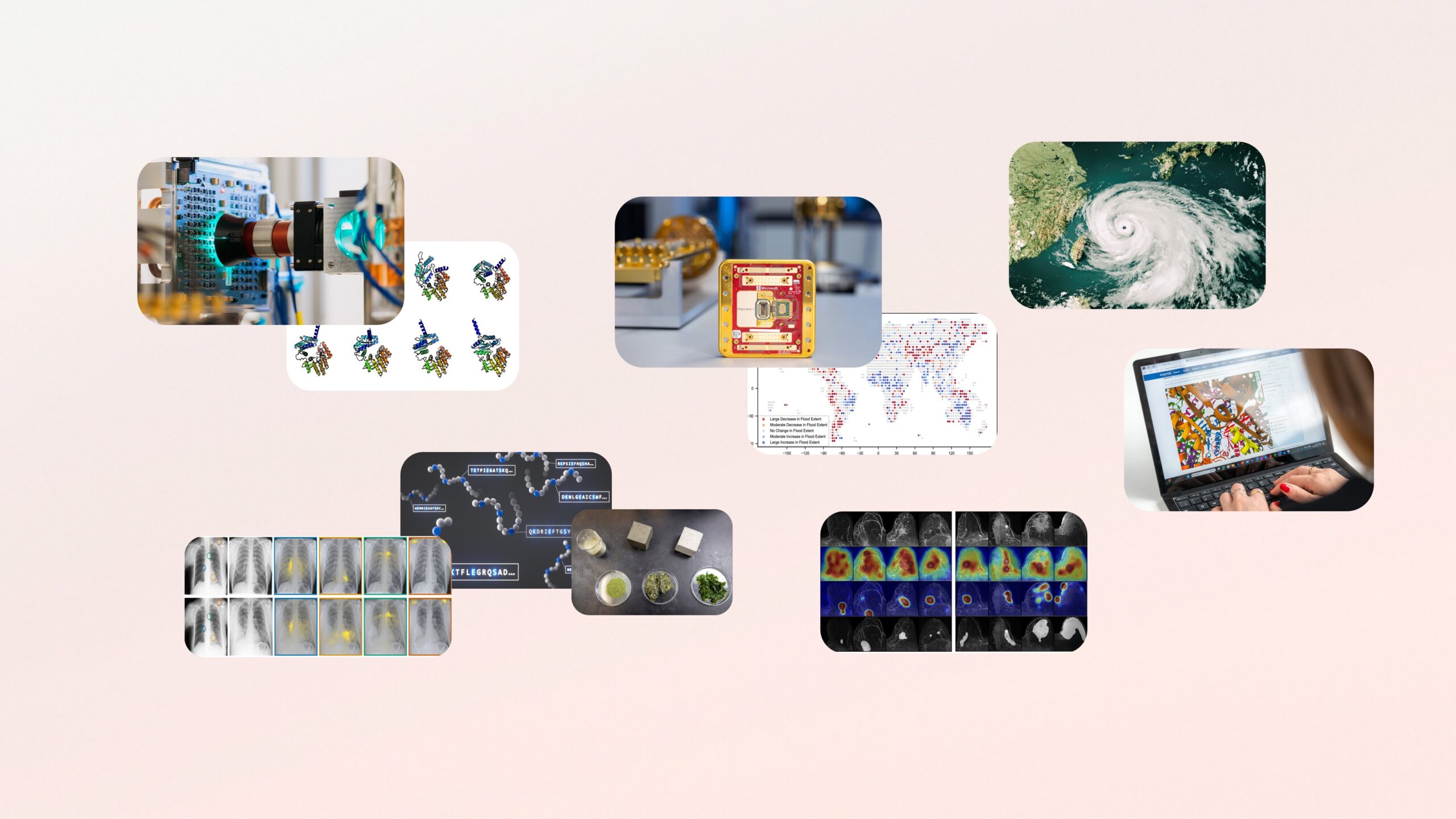
10 scientific breakthroughs from Microsoft researchers
As AI becomes a bigger part of everyday life, scientists are finding exciting new ways of harnessing its transformative power to tackle some of society’s biggest challenges.
From designing new materials to mapping flood risks through clouds, Microsoft researchers are using AI to solve problems more quickly and effectively than ever before.
With sustainability and accessibility in mind, they are also overcoming challenges in surprising new ways — like using seaweed to lower cement carbon emissions and building an energy-efficient computer that uses smartphone camera sensors and light.
In 2025, Microsoft published numerous research papers in peer-reviewed journals sharing their findings with others to build upon. Here are 10 examples that show how AI and other technologies are accelerating innovation in banking, healthcare, life sciences and energy — and charting a path for much-needed breakthroughs.
Majorana 1: The world’s first quantum processor powered by topological qubits
Imagine self-healing materials that repair cracks in bridges or airplane parts, catalysts that can break down pollutants into valuable byproducts — or breakthroughs that boost soil fertility to increase yields or promote sustainable growth of foods in harsh climates.
Research published in Nature earlier this year detailed how Microsoft researchers were able to create exotic quantum properties that led to a new type of quantum chip called the Majorana 1. The chip is powered by a new type of quantum architecture that is expected to realize quantum computers capable of solving meaningful, industrial-scale problems that today’s computers cannot — within years, instead of decades.
The chip leverages the world’s first topoconductor, a breakthrough type of material that can observe and control Majorana particles to produce more reliable and scalable qubits, the building blocks for quantum computers. While engineering work is still ahead, many difficult scientific and engineering challenges have now been met.
BioEmu-1: Faster protein stability predictions could lead to more effective medicines
Proteins make up the functional building blocks of life and are central to drug discovery and biotechnology. While there has been extraordinary progress in recent years toward better understanding protein structures using AI, many of these methods offer only a snapshot of a highly flexible molecule or require simulation times of years or even decades.
Enter Biomolecular Emulator-1 (BioEmu-1), a generative deep-learning model that provides scientists with a glimpse into the rich world of different structures each protein can adopt. This is significant because a deeper understanding of proteins could enable the design of more effective drugs, as many medications work by influencing protein structures to boost their function or prevent them from causing harm.
As explained in the journal Science, BioEmu-1 can generate thousands of protein structures per hour on a single graphics processing unit (GPU) at a fraction of the computational cost of traditional simulations. Based on this, BioEmu-1 can predict functionally relevant structure changes of proteins at unprecedented speed and predict protein stability, an important factor when designing proteins for therapeutic purposes.
MatterGen and MatterSim: AI-powered breakthroughs in materials discovery
Materials innovation drives technological progress — from batteries and fuel cells to magnets — and is essential for creating future energy breakthroughs. But identifying the next new material has long relied on costly and time-consuming experiments.
MatterGen is a generative AI tool that skips screening and instead seeks to produce novel materials based on prompts that outline design requirements for specific applications, as explained in the journal Nature.
Much like how an AI image generator turns blurry pictures into clear ones with a prompt, it starts with a random 3D structure and gradually adjusts atoms, elements and repeating patterns to create a realistic material with defined chemical, mechanical, electronic or magnetic properties.
Trained on over 600,000 examples, MatterGen achieves the state of the art in generating inorganic materials across the periodic table.
MatterGen can also work with MatterSim, an AI-powered tool that rapidly simulates material properties. Together, they can create a feedback loop that accelerates both simulation and exploration.
RAD-DINO: X-ray data meets AI technology
In healthcare, faster access to information can save lives.
Findings published in Nature Machine Intelligence show that generative AI foundation models may be able to give clinicians more accurate information and improve patient care.
A collaboration between Microsoft Research and Mayo Clinic is focused on building multimodal foundation models that integrate text and X-ray images to help doctors analyze radiology results more efficiently.
The technology, called RAD-DINO, works by identifying anatomical matches between chest X-rays of different subjects and highlighting similarities using heatmaps.
Aurora: Advanced atmospheric and weather forecasting
Microsoft’s Aurora AI foundation model leverages advances in AI to predict not just the weather, but a wide range of environmental events.
Developed by Microsoft Research, Aurora forecasts atmospheric events with greater precision and speed and at much lower computational cost than traditional systems.
Aurora learns from more than one million hours of data and generates forecasts in seconds instead of hours. Early results published in Nature have shown promise in predicting rain, enhancing crop logistics and protecting energy grids.
FCDD: Improving early breast cancer screening with AI
Breast cancer is the most common cancer among women worldwide. Early screening saves lives but often leads to high false positives and unnecessary biopsies, especially for women with dense breast tissue.
A new AI model called FCDD aims to improve detection by generating MRI heatmaps that locate suspected tumors with high accuracy. Developed through collaborations with Microsoft AI for Good Lab, the University of Washington and Fred Hutchinson Cancer Center, the model has been made open source.
Seaweed-infused cement could cut concrete’s carbon footprint
Cement is one of the largest contributors to global greenhouse gas emissions.
Researchers at Microsoft and the University of Washington developed low-carbon concrete using seaweed, a natural carbon sink. Findings published in Matter showed a 21% lower global warming potential compared to traditional cement.
Mapping floods from space — even when clouds get in the way
Floods cause extensive damage worldwide each year, but long-term global flood datasets remain limited.
A deep learning flood detection model from the Microsoft AI for Good Lab uses radar imagery to map floods through cloud cover and darkness. Findings published in Nature Communications show improved global flood monitoring and preparedness.
Analog optical computer: Accelerating AI and optimization with light
Microsoft developed an analog optical computer that uses light instead of digital electronics to solve optimization problems and accelerate AI inference.
Published in Nature, the research shows the potential for faster and more energy-efficient computation using scalable optical technologies.
Managing the risk behind the promise of AI in biology
AI is opening new frontiers in biology but also introduces biosecurity risks due to its dual-use potential.
A Microsoft-led paper published in Science describes a confidential two-year project and a tiered-access system developed with the International Biosecurity and Biosafety Initiative for Science to manage information hazards responsibly.